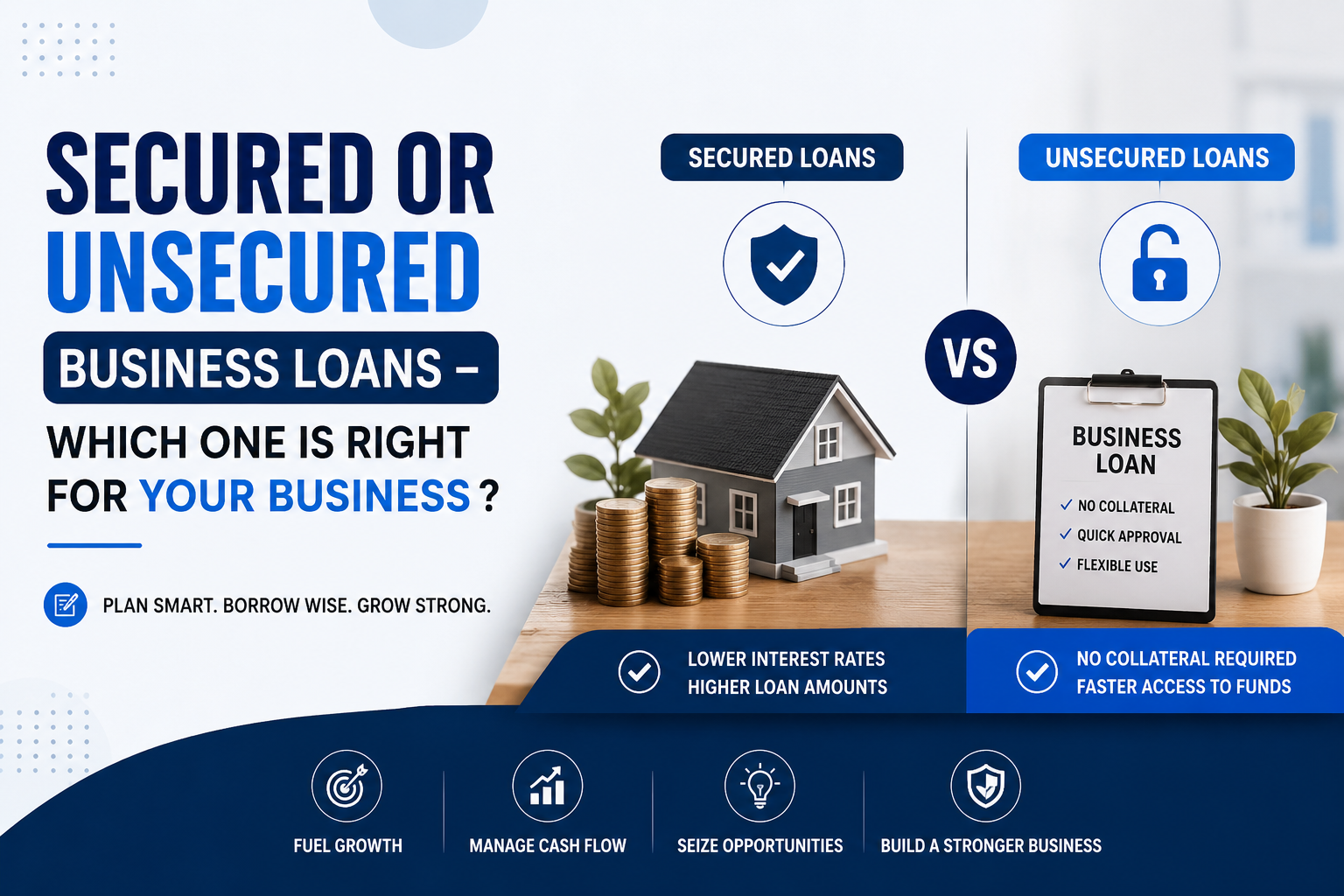
Secured or Unsecured Business Loans – Which One Is Right for Your Business ?
Business growth often requires financial support. Whether it is purchasing equipment, expanding operations, managing inventory, hiring employees, or handling daily expenses, many businesses rely on loans to maintain smooth operations. Today, business owners mainly choose between two major financing options — secured business loans and unsecured business loans.
Although both provide access to capital, they differ significantly in terms of risk, interest rates, eligibility, approval speed, and repayment structure. Choosing the wrong type of loan can increase financial pressure, while choosing the right one can support long-term business success.
What Is a Secured Business Loan ?
A secured business loan is a loan that requires collateral. The borrower pledges an asset to the lender as security against the loan amount. The collateral may include:
- Commercial property
- Residential property
- Machinery and equipment
- Vehicles
- Inventory
- Fixed deposits
- Business assets
Since the lender has security, secured loans are considered lower-risk lending products. Therefore, lenders are more willing to offer larger loan amounts with lower interest rates.
Secured loans are commonly used for long-term business investments such as:
- Business expansion
- Factory setup
- Purchasing machinery
- Infrastructure development
- Large working capital requirements
Advantages of Secured Business Loans
Lower Interest Rates
One of the biggest benefits of secured loans is affordable interest rates. Because the lender has collateral protection, the risk is reduced, which helps businesses borrow at lower costs.
Higher Loan Amounts
Businesses can access larger funds depending on the value of the pledged asset. This makes secured loans ideal for businesses planning major growth projects.
Longer Repayment Tenure
Secured loans often come with flexible repayment periods. Longer tenures reduce EMI pressure and help businesses maintain healthy cash flow.
Better Chances of Approval
Businesses with average credit scores may still receive approval if they provide strong collateral support.
Disadvantages of Secured Business Loans
Risk of Losing Assets
The major disadvantage is the possibility of losing the pledged asset if the borrower fails to repay the loan. In case of default, lenders can legally recover the outstanding amount through the collateral.
Lengthy Documentation Process
Secured loans generally involve:
- Property verification
- Asset valuation
- Legal documentation
- Financial assessment
This increases the overall processing time.
Slower Loan Disbursement
Because collateral verification takes time, approval and fund disbursement may be slower compared to unsecured loans.
What Is an Unsecured Business Loan?
An unsecured business loan does not require collateral. Instead, lenders evaluate the borrower based on:
- Business turnover
- Profitability
- Credit score
- Bank statements
- Repayment history
- Business stability
These loans have become highly popular among startups, freelancers, and small businesses because they offer quick financing without asset security.
Unsecured loans are commonly used for:
- Daily operational expenses
- Inventory purchase
- Marketing activities
- Employee salaries
- Short-term working capital
- Emergency business funding
Advantages of Unsecured Business Loans
No Collateral Requirement
The biggest advantage is that business owners do not need to pledge property or assets. This reduces financial risk for the borrower.
Faster Approval Process
Most lenders provide quick approvals for unsecured loans. Digital applications and minimal paperwork have made the process more convenient than ever.
Minimal Documentation
Compared to secured loans, unsecured financing usually requires fewer documents and simpler verification procedures.
Ideal for Small Businesses and Startups
New businesses may not own valuable assets for collateral. Unsecured loans help such businesses access funds based on income and business performance.
Disadvantages of Unsecured Business Loans
Higher Interest Rates
Since there is no collateral, lenders face greater risk. As a result, unsecured loans usually carry higher interest rates.
Lower Loan Eligibility
The loan amount approved is generally smaller compared to secured financing options.
Strict Credit Evaluation
Lenders carefully review the borrower’s credit score and repayment history. Poor credit profiles may lead to rejection or expensive borrowing terms.
Key Differences Between Secured and Unsecured Business Loans
Security Requirement
Secured loans require collateral, while unsecured loans do not require any asset pledge.
Interest Rates
Secured loans generally offer lower interest rates. Unsecured loans are comparatively more expensive due to higher lender risk.
Approval Speed
Unsecured loans are processed faster because they do not involve collateral verification.
Loan Amount
Secured financing usually provides larger funding limits based on asset value.
Risk Factor
Secured loans carry the risk of asset loss, whereas unsecured loans mainly impact the borrower’s credit profile in case of default.
Which Business Loan Is Better for You?
The answer depends entirely on your business needs and financial condition.
Choose a Secured Loan If:
- You need a large amount of funding
- You own valuable assets
- You want lower interest rates
- You prefer longer repayment tenure
- Your business is planning long-term expansion
Secured loans are best suited for established businesses with stable income and growth-oriented investment plans.
Choose an Unsecured Loan If:
- You need urgent financing
- You do not want to risk assets
- Your funding requirement is moderate
- You run a startup or small business
- You need short-term working capital
Unsecured loans are more suitable for businesses that prioritize speed, convenience, and flexibility.
Important Tips Before Applying for a Business Loan
Evaluate Your Repayment Capacity
Always calculate whether your monthly cash flow can comfortably handle loan repayments.
Compare Multiple Lenders
Different lenders offer different interest rates, processing fees, and repayment options.
Maintain a Strong Credit Score
A healthy credit profile improves approval chances and helps secure better loan terms.
Borrow Only What You Need
Excess borrowing can increase financial stress and affect business profitability.
Read Terms Carefully
Check hidden charges, foreclosure penalties, and repayment conditions before signing the agreement.
Final Thoughts
Both secured and unsecured business loans offer valuable financial support, but the right option depends on your business goals, funding urgency, asset availability, and repayment capability.
Secured loans are ideal for businesses seeking large funding at lower interest rates, while unsecured loans are better for quick access to capital without collateral obligations.
A smart borrowing decision should not only solve immediate financial needs but also support long-term business stability and growth. Before applying, carefully assess your financial situation, compare loan options, and choose a financing solution that aligns with your business strategy and future vision.